Most Walmart sellers believe that if a product is live, it’s selling-ready.
But here’s the uncomfortable truth: thousands of Walmart listings are silently suppressed every day—without warnings, errors, or notifications.
No red flags.
No dashboard alerts.
Just… zero visibility.
This is one of the biggest reasons sellers struggle with stagnant sales despite “doing everything right.”
Let’s break down why Walmart listing suppression happens, how it quietly kills visibility, and what sellers miss until it’s too late.
What Is Walmart Listing Suppression?
Walmart listing suppression is not the same as deactivation.
Your item status shows Published
Inventory appears available
No error messages are visible
Yet:
Your product doesn’t rank
It doesn’t appear in search
- Ads don’t convert
Sales suddenly flatline
This happens because Walmart’s system reduces or blocks discoverability when it detects listing quality or data issues—without informing the seller.
The Silent Killers: Why Walmart Suppresses Listings
1. Attribute Gaps (The #1 Invisible Issue)
Walmart’s catalog system relies heavily on mandatory and recommended attributes tied to each product type.
If even one critical attribute is:
Missing
Incorrect
Inconsistent with the product type
Your listing becomes algorithmically untrustworthy.
Common attribute gaps include:
Incorrect material or fabric type
Missing dimensions or weight
Incomplete color mapping
Incorrect gender/age group classification
Even if the product looks fine to a human, Walmart’s system flags it as incomplete—and quietly limits reach.
2. Product Type & Content Mismatch
One of the most overlooked Walmart listing errors is product type mismatch.
Example:
Product is listed as “Home Décor”
Content reads like “Furniture”
Attributes align with “Storage”
This creates internal conflicts.
Walmart’s algorithm struggles to understand:
Where to rank the product
Which competitors to compare it against
Which searches it should appear for
Result?
Reduced visibility without rejection.
3. Keyword Stuffing That Backfires
Unlike Amazon, Walmart does not reward aggressive keyword stuffing.
When titles or descriptions:
Repeat keywords unnaturally
Include irrelevant search terms
Don’t align with attributes
Walmart flags the listing as low-quality content.
Instead of boosting ranking, it does the opposite—quiet suppression.
4. Image–Content Inconsistency
Walmart’s system cross-checks:
Images
Attributes
Titles
Descriptions
If your images show:
Multiple items but listing says “single”
Different color than selected attribute
Accessories not mentioned in content
The listing becomes risky in Walmart’s ecosystem—and visibility is reduced to protect customer experience.
5. Legacy Errors That Never Got Fixed
Many sellers unknowingly carry:
Old catalog errors
Inherited listing issues
Incorrect setup from initial uploads
These errors don’t always block publishing—but they accumulate silently, lowering listing trust score over time.
Why Sellers Don’t Even Notice Suppression
Because Walmart doesn’t clearly say:
“Your listing is suppressed.”
Instead, sellers see:
Low impressions
Poor ad performance
Zero organic traction
And assume:
The niche is dead
Ads aren’t working
Pricing is the issue
In reality, the listing was never fully visible to begin with.
How to Detect Walmart Listing Suppression
Watch for these warning signs:
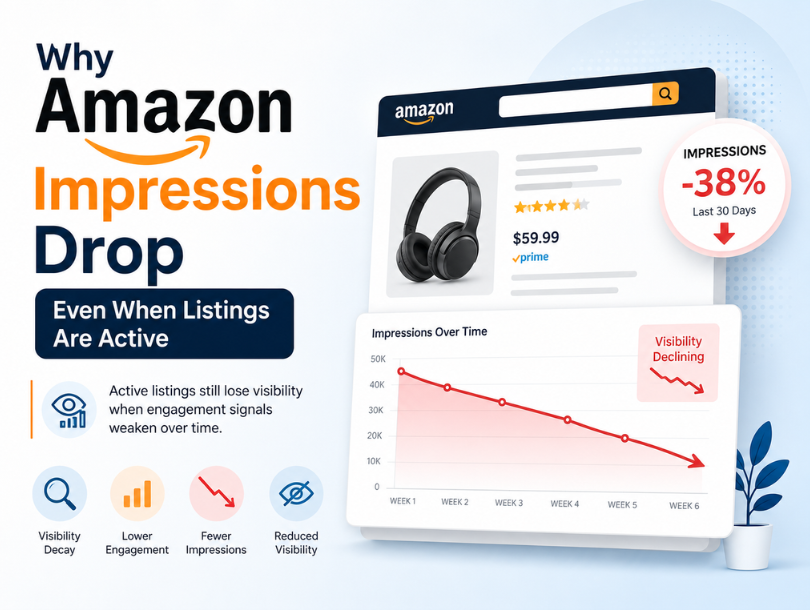
Sudden drop in impressions without inventory issues
Ads spending but not converting
Product not appearing even for exact-match searches
Sales declining despite competitive pricing
These usually point to hidden Walmart listing errors, not market demand problems.
Fixing Suppression Requires More Than “Editing Content”
True resolution involves:
Full attribute audits by product type
Catalog compliance checks
Image-to-attribute validation
Keyword-to-taxonomy alignment
Backend error cleanup
This is where professional Walmart account management becomes critical—because most suppression issues are system-level, not surface-level.
Final Thought: Visibility Is Earned, Not Assumed
On Walmart, being “live” doesn’t mean being visible.
Silent listing suppression is one of the biggest growth blockers sellers face—and the most dangerous part is not knowing it’s happening.
If your Walmart store feels stuck, the problem often isn’t traffic or ads.
It’s what the algorithm isn’t telling you.