In modern ecommerce, growth is rarely achieved alone. Businesses depend on agencies, consultants, logistics providers, technology partners, and marketplace specialists to scale operations, improve visibility, and maintain profitability. However, choosing the wrong partner can quietly damage business performance through poor execution, communication gaps, hidden inefficiencies, and short-term thinking.
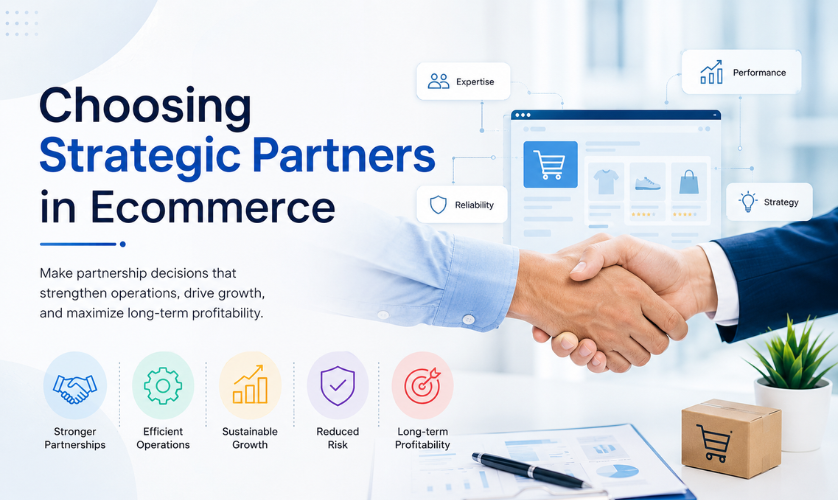
Many businesses evaluate vendors and agencies primarily on pricing. While cost matters, strategic partnerships influence far more than monthly expenses. The right partner strengthens operations, improves decision-making, protects marketplace health, and creates scalable systems that support sustainable growth.
This is why vendor and agency evaluation should focus on long-term operational value rather than temporary savings.
Why Strategic Ecommerce Partnerships Matter
Ecommerce is no longer a simple listing-and-selling business model. Brands today operate in highly competitive marketplaces where operational precision directly affects visibility, conversion rates, advertising efficiency, and customer trust.
Strategic partners often influence critical business areas such as:
- Marketplace account management
- Inventory coordination
- Advertising performance
- Product listing optimization
- Brand positioning
- Customer experience
- Data reporting and analytics
- Compliance and policy management
A weak partner creates operational friction. A strong partner improves efficiency while helping the business adapt faster to changing marketplace conditions.
Businesses that scale successfully usually treat partnerships as growth infrastructure rather than outsourced labor.
The Hidden Cost of Choosing Based Only on Pricing
Low-cost service providers often appear attractive during the early stages of evaluation. However, cheaper execution frequently creates larger long-term costs.
Some common hidden costs include:
Poor Marketplace Optimization
Weak listing optimization reduces visibility, click-through rates, and conversion performance. This directly impacts sales velocity and organic ranking.
Reactive Account Management
Partners focused only on basic task completion rarely monitor account health strategically. This can lead to suppressed listings, policy violations, inventory disruptions, or advertising inefficiencies.
Lack of Strategic Direction
Some agencies execute tasks without understanding broader business goals. Without strategic alignment, businesses experience inconsistent growth despite ongoing spending.
Communication Delays
Operational delays create inventory problems, missed campaign opportunities, and slower response times during marketplace issues.
Scaling Limitations
A low-cost provider may struggle once product catalogs, marketplaces, or advertising complexity increase.
Short-term savings often become long-term operational losses.
What Businesses Should Evaluate Beyond Pricing
Choosing the right ecommerce partner requires deeper evaluation criteria.
Industry Experience
Experience matters because marketplace ecosystems change rapidly. Partners with strong ecommerce exposure understand platform behavior, algorithm shifts, advertising trends, and operational risk areas.
Businesses should assess:
- Marketplace specialization
- Category experience
- Multi-platform management capability
- Understanding of international marketplaces
- Experience with operational scaling
Experienced partners solve problems proactively rather than reacting after damage occurs.
Strategic Thinking vs Task Execution
Many vendors focus only on completing assigned tasks. Strategic partners analyze performance patterns, identify bottlenecks, and recommend improvements before problems escalate.
A strategic ecommerce partner contributes to:
- Profitability improvement
- Advertising efficiency
- Marketplace expansion planning
- Operational automation
- Customer retention strategies
- Competitive positioning
The goal should not simply be outsourcing work. The goal should be improving business capability.
Importance of Data-Driven Decision Making
Strong ecommerce partnerships rely on analytics and measurable performance indicators.
Reliable partners should provide insights related to:
- Advertising return on investment
- Conversion rate trends
- Organic keyword performance
- Inventory forecasting
- Marketplace profitability
- Customer behavior analysis
Businesses should avoid agencies that rely only on assumptions without performance-backed recommendations.
Data-driven operations create predictable scaling opportunities.
Communication and Transparency
Operational transparency is one of the most overlooked partnership factors.
Businesses should evaluate:
- Reporting frequency
- Response timelines
- Issue escalation processes
- Strategic review meetings
- Clarity of communication
Strong partners communicate challenges early and provide actionable solutions instead of hiding operational problems.
Transparent communication reduces business risk.
Technology and Process Capabilities
Modern ecommerce depends heavily on systems and automation.
Strategic partners should demonstrate capabilities in:
- Marketplace tools
- Inventory management systems
- PPC optimization software
- Analytics dashboards
- Workflow automation
- Listing management platforms
Technology-driven operations improve efficiency, accuracy, and scalability.
Businesses that ignore operational infrastructure often struggle during growth phases.
Long-Term Compatibility Matters
The best partnerships function as long-term growth relationships rather than temporary vendor contracts.
Businesses should evaluate whether the partner:
- Understands long-term business goals
- Supports scalability
- Adapts to operational complexity
- Maintains process consistency
- Prioritizes sustainable growth
A strong partnership should strengthen operational stability over time.
Questions Businesses Should Ask Before Hiring
Before finalizing a vendor or agency, businesses should ask:
- What marketplaces do you specialize in?
- How do you measure performance success?
- What reporting systems do you provide?
- How do you handle operational emergencies?
- What scaling experience do you have?
- How do you improve profitability beyond sales growth?
- What processes ensure account health and compliance?
- How do you align strategy with business goals?
These questions reveal operational maturity and strategic capability.
Why Ecommerce Businesses Need Strategic Guidance
As marketplace competition increases, operational decisions become more important than ever. Businesses cannot rely only on basic execution support.
This is where professional Rey Ecom Ops Pvt Ltd and advanced ecommerce consulting support become valuable. Experienced partners help brands build scalable systems, optimize profitability, and navigate marketplace complexity with greater confidence.
High-performing ecommerce brands understand that strategic partnerships directly influence growth consistency, operational resilience, and long-term profitability.
Final Thoughts
Choosing strategic partners in ecommerce is not simply a procurement decision. It is a growth decision.
The right agency or consulting partner contributes to operational efficiency, marketplace performance, profitability optimization, and scalable expansion. The wrong partner creates inefficiencies that silently weaken business performance over time.
Businesses that evaluate partners based on expertise, strategic capability, communication quality, operational systems, and long-term alignment often achieve stronger and more sustainable ecommerce growth.
Pricing matters, but strategic value matters far more.