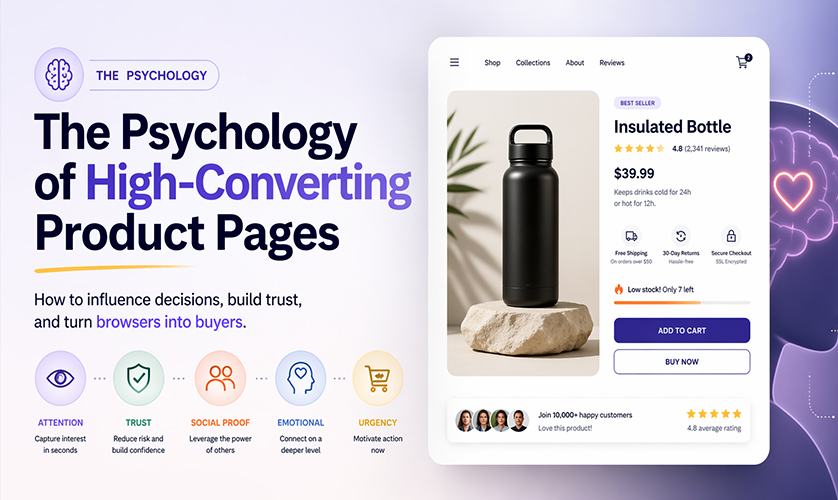
Why do some product pages convert instantly while others struggle—even with similar products? The answer lies in ecommerce conversion psychology. Buyers don’t just evaluate products logically; they assess risk, trust, and value subconsciously within seconds. A high-converting product page is designed to reduce hesitation and guide the buyer toward a confident “yes.”
1. The Hidden Driver: Risk Reduction
Every buyer asks one silent question: “What if this doesn’t work for me?”
High-converting product pages tackle this fear upfront by:
- Showing clear, high-quality images from multiple angles
- Displaying real customer reviews and ratings
- Offering easy returns, guarantees, or warranties
👉 The less risk a buyer feels, the faster the decision.
2. Visual Hierarchy: First Impressions Decide Everything
Buyers scan before they read. Within 3–5 seconds, they decide whether to stay or leave.
Winning pages use:
- Hero images that instantly communicate product value
- Zoom and lifestyle visuals to create relatability
- Clean layouts that guide the eye naturally
👉 Strong visuals don’t just attract—they validate the purchase instantly.
3. Structured Copy: Clarity Converts
Messy or long-winded content increases confusion—and confusion kills conversions.
High-performing product page optimization focuses on:
- Bullet points instead of paragraphs
- Clear sections: features → benefits → proof
- Simple, direct language
Example:
❌ “Premium fabric with enhanced stitching quality”
✅ “Feels softer, lasts longer, and keeps its shape after multiple washes”
👉 Buyers don’t buy features—they buy outcomes.
4. Benefit Clarity: Show the “Why”
A product without clear benefits feels like a risk.
To improve conversions:
- Translate every feature into a real-life benefit
- Highlight problem-solving capability
- Use emotional triggers (comfort, confidence, convenience)
👉 If the benefit isn’t obvious, the product won’t sell.
5. Social Proof: Trust Through Others
Humans follow humans. When buyers see others validating a product, their hesitation drops.
Use:
- Verified reviews
- User-generated content (UGC)
- Before/after visuals
- Testimonials with specific outcomes
👉 Social proof acts as a shortcut for decision-making.
6. Decision Triggers That Accelerate Conversion
To increase conversion velocity, integrate psychological triggers like:
- Scarcity: “Only 5 left in stock”
- Urgency: “Offer ends tonight”
- Authority: Certifications, awards, or expert mentions
- Consistency: Matching messaging across images, copy, and pricing
👉 These triggers push buyers from thinking → acting.
7. Frictionless Experience: Remove Barriers
Even small friction points can stop a purchase.
Optimize for:
- Fast loading speed
- Mobile responsiveness
- Simple checkout flow
- Clear pricing (no hidden costs)
👉 The easier it feels, the faster it converts.
Conclusion
High-converting product pages aren’t just designed—they’re engineered using ecommerce conversion psychology. By reducing risk, improving clarity, and using the right decision triggers, you don’t just attract traffic—you convert it into revenue.
The real goal isn’t more visitors. It’s more confident buyers.